

Third-Party Testing vs Label Claims: Comparison
I don’t treat a supplement label as proof of what’s inside. For Vet Treat chews - or any dog supplement - I ask for an independent lab’s Certificate of Analysis (COA) and match its lot number to the bottle.
Here’s what I check:
- Identity and amounts: Do the tested ingredients, mg per chew, and probiotic CFU match the label?
- Contaminants: Which metals, microbes, pesticides, or solvents were tested, and what limits were used?
- Dates and shelf life: Do the records support ingredient amounts and live-organism counts through expiration?
- Other claims: Manufacturing records, sourcing documents, quality seals, and clinical studies answer different questions. They don’t replace batch testing.
Quick Comparison
| What I check | Label claims | Independent lab results |
|---|---|---|
| Ingredients and amounts | Lists what should be present | Reports what was measured |
| Contaminants | May use broad purity wording | Lists tested substances, results, and limits |
| Shelf life | States an expiration date | A single test does not establish levels through expiration |
| Batch coverage | Describes the product | Applies to the tested sample and lot |
| Health effects | May claim health support | Composition testing does not prove clinical effects |
“Nondetect” does not mean zero, and one tested lot does not verify every batch. <u>Matching contents also doesn’t mean a supplement is right for your dog.</u> I’d review the dose, diet, health conditions, allergies, and medications with a veterinarian before starting.
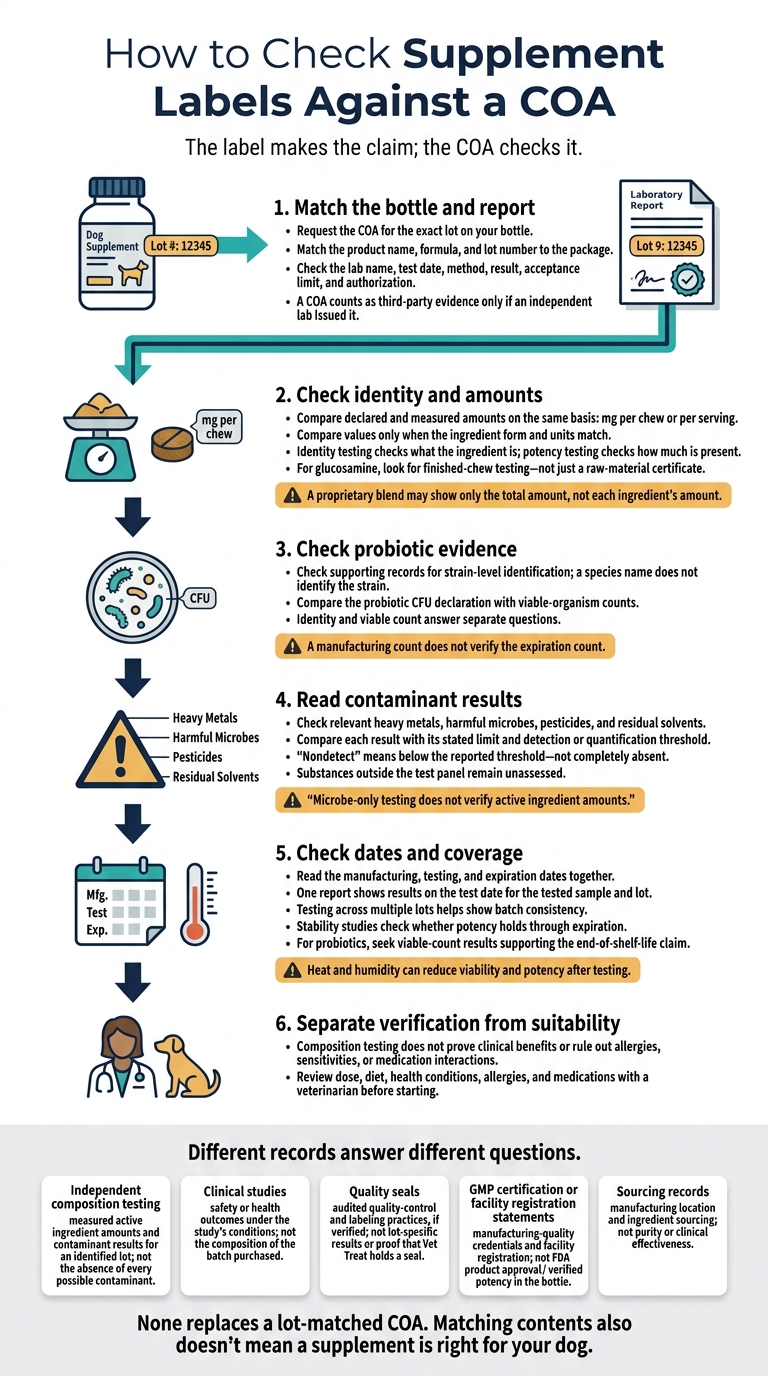
How to Check Supplement Labels Against a COA
What Labels Say and Lab Reports Show
The package tells you what the maker claims. The COA tells you what was measured. Label claims aren’t test results, and internal checks reflect the maker’s own controls. Only outside testing verifies the claim. A COA counts as third-party evidence only if an independent lab issued it.
Ingredients, Serving Sizes, and Label Claims
Check whether amounts are listed per chew or per serving, then follow the feeding directions for your dog’s weight. Match each amount to the same ingredient form and unit on the COA. A proprietary blend may list the total amount without showing how much of each ingredient it contains.
Disease claims can draw FDA scrutiny. Claims about supporting health don’t prove effectiveness.
| Label information | Corresponding lab evidence | Limitation |
|---|---|---|
| Declared glucosamine amount per finished chew | Measured glucosamine in the finished-chew sample, on the same basis | Raw-ingredient testing does not verify finished-chew potency. |
| Ingredient identity | Identity tests for the ingredients tested | Identity does not establish absorption or effectiveness. |
| Purity claims such as natural or chemical-free | Results for heavy metals, pesticides, and harmful bacteria | Marketing wording does not specify tested contaminants. |
| Probiotic CFU declaration | Viable-organism count at the test date | A manufacturing count does not verify the expiration count. |
Compare values only when the ingredient form and units match. Once you understand the label fields, check them line by line against the lab report.
Lab Reports and Certificates of Analysis
A useful COA includes enough detail to match the claim, lot, and test method. Check the lab name, product, lot, test date, method, result, acceptance limit, and authorization.
For glucosamine, look for finished-chew testing - not just a raw-material certificate. Acceptance limits tell you how results are judged. A simple “pass” tells you less than a measured value shown alongside its limit.
A COA covers only one sample. It doesn’t predict results for later batches or damage during storage.
sbb-itb-6d7d69d
Comparing Label Claims with Lab Results
Match each label claim with the test that can check it - and note what that test cannot tell you.
| Label claim | Matching test | Comparison standard | Limitation |
|---|---|---|---|
| Named ingredient, species, or strain | Identity test suited to the ingredient | Declared identity | May not verify every minor ingredient in a complex blend |
| mg per chew or serving | Quantitative potency assay | Declared amount and acceptance limits | Results apply only to the tested lot |
| “Pure,” “natural,” or “chemical-free” | Contaminant panel based on ingredient risk, covering relevant metals, microbes, pesticides, or residual solvents | Stated contaminant limits and detection thresholds | Substances outside the panel remain unassessed |
Matching records establish traceability. Results from multiple lots help show consistency.
Here’s how to read each claim.
Active Amounts and Ingredient Identity
Compare the measured mg per chew or serving with the declared amount and acceptance limits. Identity testing checks what the ingredient is. Potency testing checks how much is present.
For probiotics, a species name does not identify the strain. Check the supporting records for strain-level identification. Identity and viable count answer separate questions: identifying the organism does not tell you how many live organisms remain.
Purity and Contaminant Tests
Check whether the panel covers heavy metals, harmful microbes, and any pesticides or residual solvents relevant to the ingredients and processing. Compare each result with its stated limit and detection or quantification threshold.
“Nondetect” means below the reported threshold - not completely absent. A limited panel cannot rule out every contaminant.
Shelf Life and Batch Consistency
Read the manufacturing, testing, and expiration dates together. One report shows results on the test date; testing across multiple lots helps show batch consistency. Stability studies check whether potency holds through expiration.
For probiotics, look for viable-count results that support the end-of-shelf-life claim - not just the count at blending. Heat and humidity can reduce viability and potency after testing.
To assess shelf life for the bottle you bought, check that its lot matches the report and that the test date applies.
Checking Test Records for Vet Treat Chews
Match the Report to the Product and Lot
Using Vet Treat as an example, request the certificate of analysis (COA) for the exact lot on your bottle. Match the report’s product name, formula, and lot number to the package.
The report should include the exact product name and formula, matching package lot number, and a test date tied to that batch. Also check for named ingredients with measured amounts, clear units, named test methods, and stated limits.
Microbe-only testing does not verify active ingredient amounts.
If the report isn’t posted, contact Vet Treat and request the COA for your bottle’s lot number. Without a matching record, potency and contaminant screening remain unverified.
Lab Tests vs Clinical and Manufacturing Claims
Different claims need different records. Here’s what each record can - and can’t - tell you.
| Record type | What it supports | What it does not establish |
|---|---|---|
| Independent composition testing | Measured active ingredient amounts and contaminant results for an identified lot. | Clinical benefits or the absence of every possible contaminant. |
| Clinical studies | Safety or health outcomes under the study’s conditions. | The composition of the batch you purchased. |
| Quality seals | Audited quality-control and labeling practices, if the seal is verified. | Lot-specific results or proof that Vet Treat holds that seal. |
| GMP certification or facility registration statements | Manufacturing-quality credentials and facility registration. | FDA product approval or verified potency in the bottle. |
| Sourcing records | Evidence of manufacturing location and ingredient sourcing. | Purity or clinical effectiveness. |
For claims such as natural-ingredient, non-GMO, made-in-the-USA, veterinarian-recommended, and clinically tested, ask for the supporting sourcing, formulation, and study records. None replaces a lot-matched COA.
Conclusion: Use Labels and Lab Reports Together
The label makes the claim; the COA checks it. Use the label for directions and the COA to verify potency and contaminant test results for the specific lot.
Before giving your dog Vet Treat chews, check the label’s per-chew amounts and directions. Compare those amounts with a lot-matched COA that reports potency and relevant contaminant tests. This checks accuracy - not whether the supplement is right for your dog.
Lab verification doesn’t guarantee clinical effectiveness or rule out allergies, sensitivities, or medication interactions. Before starting, discuss the supplement, dose, your dog’s current diet, and medications with your veterinarian.
FAQs
How can I verify that a COA is authentic?
Match the lot number on the Certificate of Analysis (COA) to the one on your product packaging. Ask the manufacturer for current records to confirm that the report covers the formula you purchased.
The COA should clearly state what was tested, such as potency, purity, or contaminants. If details are missing or unclear, ask the brand for a summary you can share or confirmation from the testing laboratory.
What if lab results don’t match the label?
Lab results that don’t match the label don’t verify the product. Check that your package’s lot number matches the report. If records are missing, inconsistent, or unclear, ask the brand for current certification or sourcing documents.
Make sure testing addresses the specific claim, such as GMO sourcing or active ingredient potency - not just purity or consistency. If you’re still unsure, consult your veterinarian.
What should I do if my lot’s COA is unavailable?
Ask the manufacturer or certifier for current certification records and test reports for your package’s lot number. Confirm which ingredients were tested, which high-risk inputs were assessed, and whether verification covers the current formula.
If supplier records are confidential, request a shareable summary or confirmation. Don’t treat the claim as verified if it’s unclear whether the records cover your lot or what the tests checked.