

Non-GMO Certifications: What Dog Owners Need to Know
I check the exact dog supplement - not just a “non-GMO” label. Before buying, I match the formula to certification records, ask about ingredient and animal-feed sourcing, and review the dose with my veterinarian.
Here’s how I separate the claims:
- Non-GMO Project Verified: Checks GMO-avoidance practices, sourcing, and testing of high-risk inputs. It does not mean every finished batch was tested.
- USDA Organic: Bans genetic engineering and sets organic production rules. Products labeled “organic” need at least 95% organic ingredients; “made with organic ingredients” requires at least 70% and cannot carry the USDA seal.
- No certification shown: A claim needs supporting records. A missing seal does not prove GMO content.
- NASC seal: Addresses quality controls - not non-GMO status.
For Vet Treat or any other brand, I request records for the specific allergy chew and match any lot-specific report to my package. <u>Non-GMO does not mean safer, allergen-free, or effective.</u> Ingredient amounts, dosing, and veterinary advice still matter.
Non-GMO Project Compliance for Animal-Derived Ingredients and Products
sbb-itb-6d7d69d
Non-GMO Project Verified vs. USDA Organic
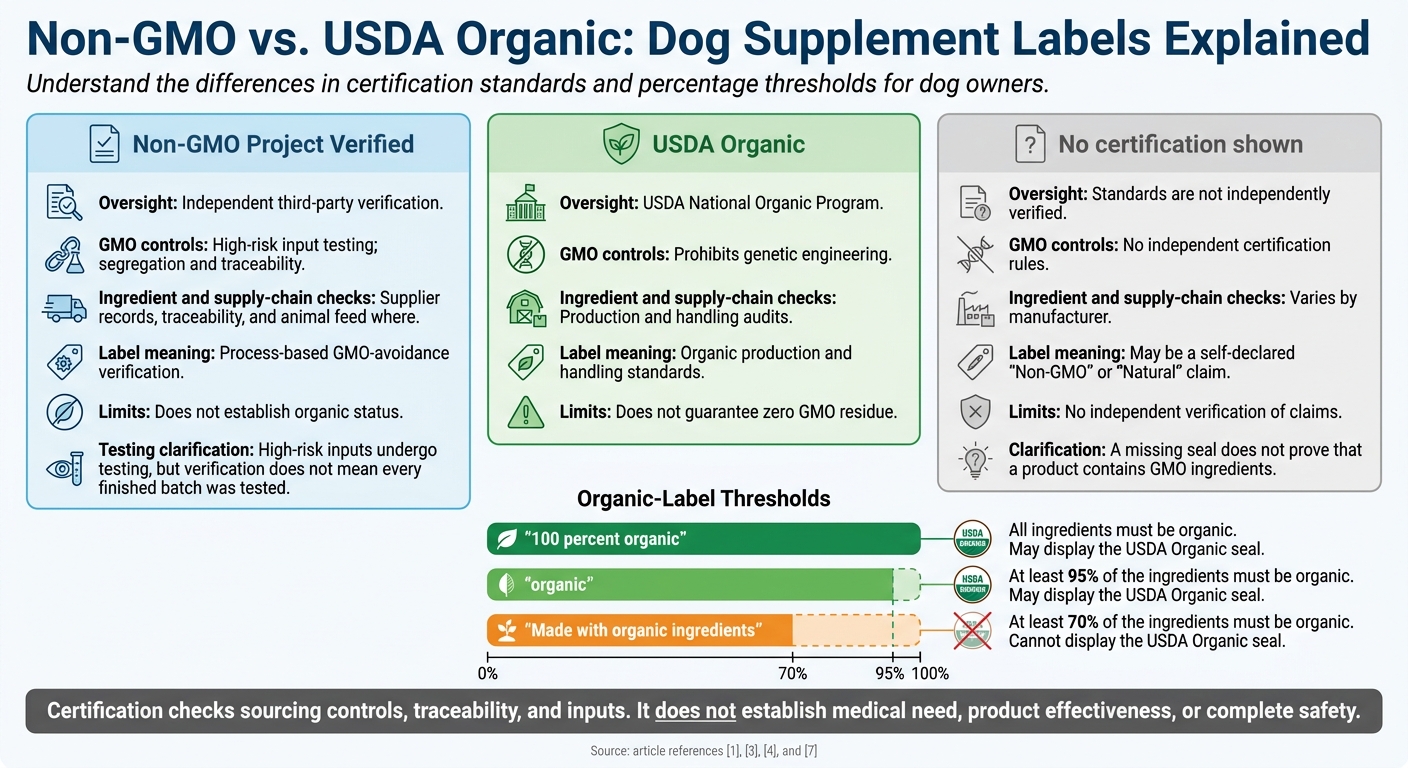
Non-GMO vs. USDA Organic: Dog Supplement Labels Explained
Once you’ve read the label claims, use the chart below to compare what each certification covers. Their sourcing rules differ, and a missing seal does not prove that a product contains GMO ingredients.
| What to compare | Non-GMO Project Verified | USDA Organic | No certification shown |
|---|---|---|---|
| Oversight | Independent third-party verification | USDA National Organic Program | Standards are not independently verified |
| GMO controls | High-risk input testing; segregation and traceability | Prohibits genetic engineering | No independent certification rules |
| Ingredient and supply-chain checks | Supplier records, traceability, and animal feed where required | Production and handling audits | Varies by manufacturer |
| Label meaning | Process-based GMO-avoidance verification | Organic production and handling standards | May be a self-declared “Non-GMO” or “Natural” claim |
| Limits | Does not establish organic status | Does not guarantee zero GMO residue | No independent verification of claims |
What Non-GMO Project Verification Checks
Non-GMO Project verification checks the process, not claims about the finished product. It sorts ingredients by GMO risk and reviews traceability, segregation, supplier records, and animal feed sourcing where required. High-risk inputs undergo testing, but verification does not mean every finished batch was tested.
What USDA Organic Labels Mean
USDA Organic focuses on production rules rather than a non-GMO-only review. Its standards ban genetic engineering and set broader rules for production and handling.
The label wording tells you how much of the product must be organic:
“100 percent organic”
All ingredients must be organic.
“organic”
At least 95% of the ingredients must be organic. Both of these labels may display the USDA Organic seal.
“Made with organic ingredients”
At least 70% of the ingredients must be organic, but this label cannot display the USDA Organic seal.
What Certification Does Not Prove
Certification checks sourcing controls, traceability, and inputs. It does not establish medical need, product effectiveness, or complete safety.
How to Verify a Dog Supplement’s Non-GMO Status
Verify the exact product through certification records - not just the brand’s claim.
Match the Product to Certification Records
Search the official Non-GMO Project product records. Match the product name, formula, flavor, and size to your package. A brand-wide claim doesn’t necessarily cover every item in the line. If the details don’t match, ask the manufacturer to explain.
For organic claims, check the exact product and the certifier named on the package against the USDA Organic Integrity Database. An operation listing confirms only that the facility is certified. Check that your exact chew appears among the listed products. If it doesn’t, contact the manufacturer or certifier.
Check High-Risk Ingredients and Animal Feed
Read the full formula for ingredients made from corn, soy, canola, sugar beet, and alfalfa. These can include sweeteners, oils, binders, proteins, and flavors. Ask about carriers and hidden processing aids, too.
For meat, dairy, egg, or gelatin, ask how the certification standard handles animal feed - and which sourcing records show that the ingredients meet its requirements.
Ask for Current Supporting Records
Request current certification records, supplier statements, feed records, or relevant test reports. Ask which ingredients were checked, how high-risk inputs were assessed, and whether verification covers the current formula. For a lot-specific report, match its lot number to the one on your package.
A COA supports a non-GMO claim only if it includes GMO testing or sourcing details. Purity or potency data alone isn’t enough. If supplier records are confidential, request a shareable summary or confirmation from the certifier. Don’t treat the claim as verified if its coverage is unclear.
If the records don’t fully match the product, check the ingredient list next.
Reading Labels and Vet Treat Product Pages
When records are incomplete, the label and product page can help you spot what still needs verification.
Check Unclear Ingredient Names
“vegetable oil,” “natural flavor,” and “plant-based blend”
These terms don’t tell you where ingredients come from. A proprietary blend may also leave out specific ingredient doses and sources. Vague wording does not prove GMO content. It signals missing sourcing details.
Read the full label to identify ingredients. Then use the lot number and contact details to request sourcing records for unclear items. The label, lot number, and contact details alone do not prove non-GMO status.
Keep Non-GMO Claims Separate From Other Labels
Treat “Non-GMO” and “made with non-GMO ingredients” as manufacturer claims unless independently verified. “Natural,” “made in the USA,” and “veterinarian-recommended” do not establish non-GMO certification.
Treat “clinically tested” as a separate claim, too.
Clinical testing addresses performance or safety - not ingredient sourcing. Ask what was tested and which outcomes were measured.
Check the Specific Vet Treat Chew
Verify the exact chew, not the brand as a whole.
On Vet Treat product pages, match the chew, formula, and size to your package. Then check whether certification or sourcing records cover that specific product. A site-wide badge does not establish certification for an individual chew.
If details are missing or inconsistent, ask Vet Treat for current certification or sourcing records for that product. If the page mentions third-party testing, ask whether it covered GMO sourcing or only purity and consistency.
Conclusion: Your Non-GMO Buying Checklist
Before buying any dog supplement, check these three things:
- Certification: Match the exact supplement to official Non-GMO Project Verified or USDA Organic records. Claims like natural and made in the USA are not certifications.
- Traceability: Check the lot number and expiration date. Ask for current records, such as a COA or test results.
- Safety: Check ingredient amounts, dosing, and GMP controls. An NASC seal supports quality control - not non-GMO status. Review the label with your veterinarian before use, especially if your dog is pregnant, senior, ill, taking medication, or on a restricted diet. Store chews out of reach.
FAQs
What if my dog’s supplement certification expires?
An expired certification may no longer confirm that a supplement meets the quality or ingredient standards checked when it was certified. Pet supplements aren’t regulated like pharmaceuticals, so certifications help indicate label accuracy and quality control.
Always check current standards with the manufacturer. Look for transparent brands like Vet Treat that use third-party testing, U.S. FDA-registered, GMP-certified manufacturing facilities, and natural, non-GMO ingredients without artificial fillers.
Can a formula change affect non-GMO certification?
Yes. Any formula change requires re-verification because non-GMO certification depends on the specific ingredients used. The entire formula must be reviewed to confirm that new or replacement ingredients meet non-GMO standards and that the certification remains valid.
Pet owners should check that the updated product meets the same quality and non-GMO testing standards as the original.
Is a non-GMO chew worth the extra cost?
A non-GMO chew may be worth the extra cost when the label comes with more than marketing claims: cleaner ingredient sourcing, a vet-formulated and clinically tested formula, third-party safety testing, and clear dosing instructions.
Vet Treat’s chews are labeled non-GMO, vet-formulated, and clinically tested. They’re made in FDA-registered/GMP-certified facilities and undergo third-party testing for purity, consistency, and effectiveness. A money-back guarantee lets you assess the results without feeling locked in.