

Do Natural Dog Supplements Outperform Synthetic Ones?
Natural dog supplements don’t outperform synthetic ones by default. I’d choose based on your dog’s needs, the ingredient form, dose, and quality testing - not its source. Start with your veterinarian: a dog eating complete and balanced food usually doesn’t need a multivitamin.
Here’s what I’d check before buying:
- Research: EPA and DHA have more support for joint care than glucosamine and chondroitin. Probiotics need strain-specific research; calming blends have limited support.
- Form and dose: Natural vitamin E has higher biological activity, but that doesn’t prove better health results. Synthetic nutrients can suit treatment that needs exact dosing.
- Daily use: Chews, powders, and liquids differ in calories, storage, measurement, and cost per daily serving - not just convenience.
- Safety and claims: Check active amounts, testing records, and medication interactions. For Vet Treat or any brand, ask whether studies tested the finished product in dogs.
- Results: I’d track symptoms for 2 weeks before starting, then try one supplement at a time with a vet-set review date.
<u>Quick Comparison</u>
| What I’d compare | Natural sources | Synthetic sources |
|---|---|---|
| Source | Plants, animals, or minerals | Manufactured nutrient forms |
| Dose consistency | Amounts can vary by batch | Exact amounts may be easier to maintain |
| Storage | Some ingredients are sensitive to heat, light, or moisture | Some formulas last longer |
| Quality checks | Test source materials for contaminants | Test for manufacturing impurities |
| Results and safety | Depend on the ingredient, form, and dose | Depend on the ingredient, form, and dose |
My rule: choose the product with research that fits your dog’s problem - not the label that sounds healthier.
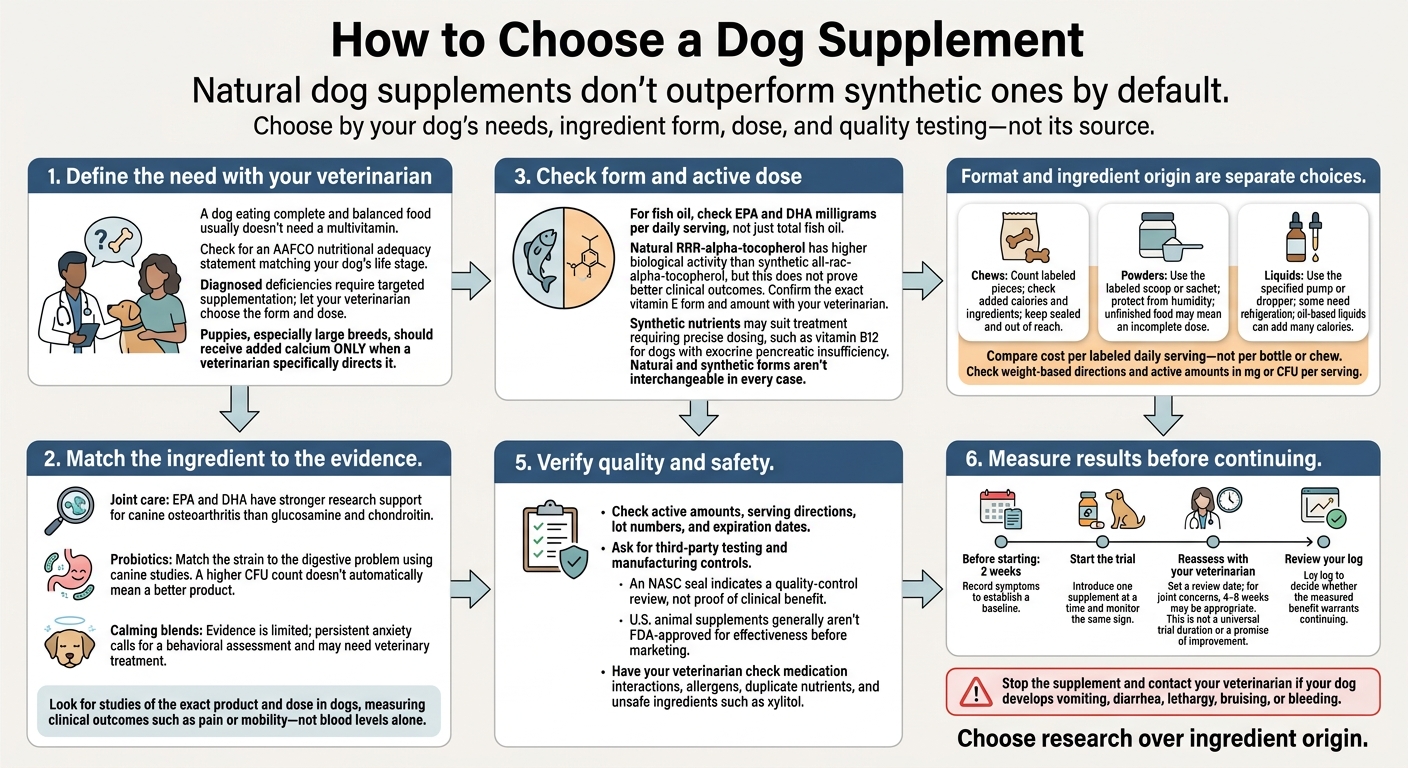
How to Choose a Dog Supplement
What Does Canine Research Show?
Few canine studies directly compare natural and synthetic forms. And higher biological activity doesn’t guarantee better clinical results. Look for published canine trials that measure pain, mobility, or other clinical outcomes. Blood levels alone don’t prove a benefit.
The question isn’t whether a supplement is natural. It’s whether the specific ingredient has evidence to support your dog’s goal.
Which Ingredients Have the Most Research Support?
EPA and DHA have stronger research support for canine osteoarthritis than glucosamine and chondroitin.
Glucosamine findings are mixed; one randomized, double-blind trial found improvements by day 70, but that result applies only to the studied product and dose.
Judge joint supplements by ingredient, dose, and measured outcome. Ask your veterinarian to check the actual EPA and DHA amounts - not just the total “fish oil” amount. Healthy dogs eating complete diets rarely need extra vitamins, while diagnosed deficiencies call for targeted supplementation.
Some nutrients differ by form. Vitamin E is the clearest example.
When Might a Natural Form Work Better?
Natural RRR-alpha-tocopherol has higher biological activity than synthetic all-rac-alpha-tocopherol, so dose needs may differ, but higher activity does not prove better outcomes. Synthetic vitamin E may require a higher dose to match activity; confirm the exact form and amount with your veterinarian.
Food-derived ingredients and botanical blends also need evidence for the exact product and dose.
In other cases, a defined synthetic nutrient may be a better fit because dosing needs to be precise.
When Might a Synthetic Form Be a Better Fit?
Synthetic nutrients fit best when veterinarians need controlled dosing for a diagnosed deficiency, such as vitamin B12 in dogs with exocrine pancreatic insufficiency.
Whether the forms are equivalent depends on the compound. Natural and synthetic forms aren’t interchangeable in every case.
sbb-itb-6d7d69d
Which Supplement Matches Your Dog's Health Needs?
Joint Mobility and Skin Health
Match the supplement to your dog's problem and the evidence behind it. For joint stiffness, check EPA and DHA milligrams per daily serving, not the total amount of fish oil. Choose products that clearly list the active dose and deliver it consistently, whether the source is natural or synthetic.
Omega-3s can offer support, but they don't replace a diagnosis. For itchy skin, they may help support the skin barrier and ease allergic itching. They won't diagnose or treat fleas, other parasites, or infections. Before trying a supplement for stiffness or scratching, record a two-week baseline so you can track changes.
Digestive Health and Anxiety
For probiotics and calming blends, the ingredients matter more than the claims on the label. Match the probiotic strain to the digestive problem, guided by canine studies rather than a “natural” label. A higher colony-forming unit (CFU) count doesn't automatically mean a better product. Follow the storage instructions, and seek veterinary care for warning signs such as bloody stool, vomiting, or sudden lethargy.
Evidence for calming blends is limited. Ask your veterinarian whether the formula and dose have been studied and whether the ingredients could interact with medications or anesthesia. Persistent anxiety calls for a behavioral assessment and may need veterinary treatment.
Daily Nutrition and Diagnosed Deficiencies
Daily supplements aren't the same as veterinarian-directed treatment for a diagnosed deficiency. Before adding vitamins or minerals, check your dog's food for an AAFCO nutritional adequacy statement that matches their life stage. Don't combine nutrient supplements without veterinary review - excess nutrients can be toxic. Puppies, especially large breeds, should receive added calcium ONLY when a veterinarian specifically directs it.
When treating a deficiency, synthetic nutrients may be a better fit if precise dosing matters. Let your veterinarian choose the form and dose. Dogs with kidney, liver, gastrointestinal, or endocrine disease need a plan tailored to them, as do dogs taking medication. Senior dogs with increased thirst or weight loss need an exam, not an “age support” supplement.
Does Supplement Format Affect Results?
Once you’ve chosen an ingredient, the format can affect how consistently you give it. Format and ingredient origin are separate choices. Chews, powders, and liquids differ in taste, dose measurement, storage, and ease of daily use. A chew your dog happily eats may be easier to give every day, but that doesn’t make it more effective.
Compare Chews, Powders, Liquids, and Daily Cost
| Format | Administration and dose measurement | Storage | Added calories or ingredients | Limitations |
|---|---|---|---|---|
| Chews | Give as treats; count the labeled number of pieces | Keep sealed and follow label directions | May contain fats, flavors, and binders | Heat and moisture can affect sensitive probiotics; store out of reach to prevent accidental ingestion |
| Powders | Mix into food; use the labeled scoop or sachet | Protect from humidity after opening | Often have fewer added ingredients; check calories | If your dog leaves food behind, they may not eat the full dose |
| Liquids | Add to food; measure with the specified pump or dropper | Some need refrigeration and must be used soon after opening | Oil-based liquids can add many calories | Watch dose measurement and shelf life; live cultures may lose potency |
Next, check what you’ll pay each day. Compare cost per labeled daily serving - not per bottle or chew. Follow the label’s directions for your dog’s weight in pounds, and check the active amounts in mg or CFU per serving.
Check Labels, Quality Testing, and Safety
Look for active amounts, serving directions, lot numbers, and expiration dates. Ask about third-party testing and manufacturing controls. An NASC seal indicates a quality-control review, not proof of clinical benefit. Also check whether published research used the same formula and dose.
“Natural,” “non-GMO,” “USA-made,” and “clinically tested” alone don’t establish effectiveness. U.S. animal supplements generally aren’t FDA-approved for effectiveness before marketing. Have your veterinarian check for allergens, medication interactions, duplicate nutrients, and unsafe ingredients such as xylitol. Store tasty chews securely, just as you would medication.
Apply these same label checks when reviewing any product’s claims.
Use the Checklist to Assess Vet Treat
For a Vet Treat chew, check brand claims against current labels and testing records. Ask whether clinical testing studied the finished chew in dogs - not just its individual ingredients - and whether it measured safety, effectiveness, or both. The supplied 15-in-1 product information lists 300 million CFU of probiotics. Confirm the serving size and the potency guaranteed through expiration.
Check active amounts, weight-based servings, daily cost, and suitability with your veterinarian. Request testing records rather than relying on reviews or label claims. Do not replace veterinarian-approved flea-and-tick prevention with a chew unless product-specific studies support that use.
Conclusion: Choose Research Over Ingredient Origin
Choose the form backed by the best evidence for your dog’s health goal - not the one that sounds more natural.
Work with your veterinarian to define the goal, review research on the exact ingredient form and dose, and confirm quality testing. Check your dog’s nutrient intake before adding more. Change only one variable at a time so you can judge the result.
Introduce one supplement at a time. Track symptoms for 2 weeks before starting, then monitor the same sign during the trial. Set a reassessment date; for joint concerns, 4–8 weeks may be appropriate. Stop the supplement and contact your veterinarian if your dog develops vomiting, diarrhea, lethargy, bruising, or bleeding. At reassessment, review your log to decide whether the measured benefit warrants continuing.
FAQs
Can I switch between natural and synthetic supplements safely?
Yes, but treat it like a medication change. Confirm a diagnosed need and make sure your dog eats complete, balanced dog food. Change one product at a time and watch for side effects. Avoid doubling up on nutrients: vitamins A and D can build up in the body, and too much calcium can be harmful.
Check with your vet before adding supplements if your dog takes prescription medications. If a formula changes, recheck the dose and any natural/non-GMO claims on the label.
How can I tell if a supplement is helping my dog?
Before starting a supplement, track your dog’s behavior for two weeks to establish a baseline. Note stiffness on stairs, coat quality, how often your dog itches, and energy levels.
Most supplements need time to build up in your dog’s system. Give the supplement daily for 4 to 8 weeks before assessing results. If you don’t see clear improvement, talk with your veterinarian about changing the dose, switching formulas, or trying other treatment options.
Should my dog’s supplements change with age?
Your dog’s supplement needs can change with age and health. Healthy dogs eating a complete and balanced diet often don’t need supplements. Aging dogs, though, may benefit from support for their joints, digestion, or immune system.
Review your dog’s supplements during wellness exams, and talk with your veterinarian before adding a supplement or changing a dose. After starting a new supplement, watch for visible improvements over 6 to 8 weeks.