

Joint Chews Vs Powder: Dog Mobility Support
I’d choose joint chews or powder based on the daily dose and what your dog will eat - not the format alone. Start with the serving for your dog’s weight: 1 chew or scoop may not equal a full day’s dose.
I’d compare ingredients, active amounts, calories, allergens, and quality checks first. Then I’d weigh prep time, chewing comfort, meal habits, storage, and travel.
Quick Comparison
| What I’d check | Joint chews | Joint powder |
|---|---|---|
| Daily routine | Offer directly; confirm every piece is eaten | Measure, mix, and check for leftovers |
| Serving size | Fixed pieces within label directions | Measured portions within label directions |
| Acceptance | Flavor and texture matter; requires chewing | Taste and smell matter; no chewing needed |
| Calories and allergens | Check flavors, binders, and daily calories | Check ingredient sources and daily calories |
| Storage and travel | Protect from heat and moisture | Keep sealed; pack the product’s measuring tool |
| Formula and quality | Compare daily active amounts and testing | Apply the same checks |
The formula still matters. I’d check EPA and DHA amounts - not just total fish oil - and remember that ingredient research or a quality seal doesn’t prove a finished product works.
<u>Supplements don’t cure osteoarthritis or replace veterinary care.</u> Before starting, switching, or combining products, I’d ask your veterinarian to review medications and duplicate ingredients. New or worsening movement problems need an exam, alongside a plan for weight, exercise, and treatment.
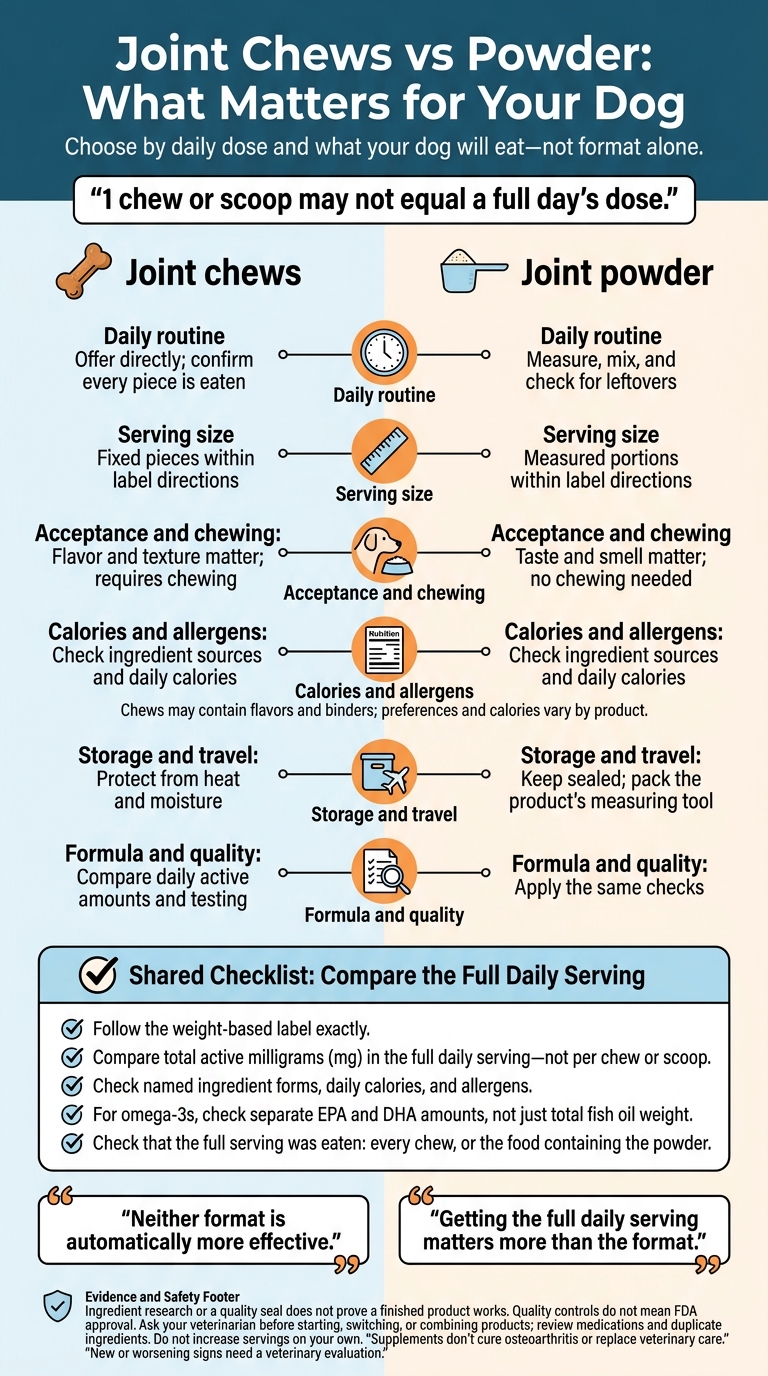
Joint Chews vs Powder: What Matters for Your Dog
How to Give Joint Chews and Powders
Daily support depends on your dog eating the full serving. With chews, you can check that each piece was eaten. With powders, getting the full dose depends on finishing the food it’s mixed into.
| Format | Daily Dose Check | Common Intake Problems |
|---|---|---|
| Chews | Confirm the full serving was eaten. | Mouth pain, texture preferences, missed or double doses. |
| Powders | Check for leftovers. | Spills, bowl residue, food refusal, or unfinished meals. |
Chews: Pre-Portioned Servings
One chew may not equal one daily serving. Follow the weight-based label exactly. Track each dose to avoid giving it twice, and count chew calories toward your dog’s daily intake.
If your dog refuses a chew, try offering it with a little familiar food, as the label allows. If chewing seems uncomfortable, ask your veterinarian for guidance. Powder mixed into food may be easier for some dogs.
Powders: Measured Servings
Use the label scoop and measure the exact serving size. Mix it thoroughly into food; a little water or wet food can help the powder stick to kibble.
Check the bowl afterward. Residue or an unfinished meal means your dog didn’t get the full dose. Measuring also adds a daily task, and a new taste or smell may make your dog refuse food. Stick to the labeled amount - a larger serving doesn’t mean better support.
sbb-itb-6d7d69d
Chews vs. Powders: Daily Convenience
Chews take less prep; powders give you more control over serving size. The right fit depends on your feeding routine, your dog’s preferences, and how much measuring you want to do each day. Getting the full daily serving matters more than the format. Once you know the dose, convenience can be the tiebreaker.
| Factor | Joint Chews | Joint Powder |
|---|---|---|
| How it’s given | Offered directly as a treat | Mixed into food as directed |
| Dose flexibility | Fixed, pre-portioned servings within labeled weight ranges | Measured servings are easier to split within label directions |
| Acceptance | Treat-like flavors may appeal to many dogs | Depends on the food and how well the powder is mixed |
| Chewing difficulties | Soft chews may suit dogs with sensitive teeth, but still require chewing | No chewing required |
| Calories | Flavorings and binders can add calories | Generally lower; check the product |
| Preparation time | Little preparation | Requires measuring and mixing at mealtime |
| Storage and travel | Easy to carry; protect from heat and moisture | Keep the container sealed and pack its measuring tool |
Preferences and calories vary by product.
Feeding multiple dogs? Follow each dog’s weight-based directions and keep a separate record. Watch each dog finish its own portion so one doesn’t eat another’s supplement.
Follow the storage directions, too. Heat and moisture can make chews stick or powders clump. If you travel with powder, pack the measuring tool made for that product.
Next, compare the ingredients and daily serving before choosing a format.
Compare Ingredients, Evidence, and Daily Doses
Once the routine works, compare what each full daily serving delivers. Neither format is automatically more effective. What matters is the active ingredients, their forms, and the full daily dose your dog gets.
Common Joint Ingredients and Their Evidence
Joint formulas may contain glucosamine, chondroitin, MSM, omega-3 fatty acids, or green-lipped mussel. Evidence for glucosamine and chondroitin is mixed. Omega-3s have stronger support for helping manage osteoarthritis-related discomfort. MSM and green-lipped mussel are also common additions.
Research on a single ingredient doesn’t prove that a finished blend will work the same way. Compare the label details, not just the package type.
Read Labels by Full Daily Serving
Find the labeled daily serving for your dog’s weight. Then compare the total active amounts in that serving - not per chew or scoop. For omega-3s, check the separate EPA and DHA amounts, rather than total fish oil weight.
| Label Check | Chew Label | Powder Label |
|---|---|---|
| Serving units | Chews per day for your dog’s weight range | Scoops or measured amount per day for your dog’s weight range |
| Daily active amounts | Total milligrams (mg) across all daily chews | Total mg across the full daily measured serving |
| Ingredient forms | Look for named forms, such as glucosamine HCl | Look for the same detail; a vague “joint blend” alone tells you less |
| Calories | Check calories for the full daily serving | Check calories for the full daily serving |
| Allergens and other ingredients | Review flavors and binders separately from active ingredients | Review ingredient sources and added ingredients for known allergens |
Quality seals, third-party testing, and FDA-registered or GMP-certified manufacturing indicate quality controls - not effectiveness or FDA approval.
After comparing doses, check for ingredients in products your dog already takes.
Avoid Duplicate Ingredients and Excess Doses
Before adding a supplement, have your veterinarian review your dog’s medications, diet, and other supplements. This is especially important if your dog takes anti-inflammatory drugs.
Follow the label and your veterinarian’s guidance. Don’t combine formulas or increase servings on your own. Excess intake can cause adverse effects, including stomach upset. Keep supplements - especially treat-like chews - out of reach to prevent accidental overconsumption.
Conclusion: Choose a Format Your Dog Takes Consistently
Compare ingredients, dose, and your daily routine, then pick the format your dog will take every day. If your dog won’t finish one format, try the other so they get the full daily dose. Before starting or switching, ask your veterinarian what suits your dog’s needs - especially if your dog has osteoarthritis, takes other medications, or needs weight management. Include treat and supplement calories in the daily total.
New or worsening signs need a veterinary evaluation, not just a different product. These signs may include bunny-hopping or reluctance to jump. Use supplements alongside weight management, regular exercise suited to your dog, and prescription care when needed.
FAQs
How long should I try a joint supplement?
Veterinarians typically recommend a 4- to 12-week trial, with a check-in around weeks 6 to 8. Some dogs show improvement within 2 to 4 weeks.
Track your dog’s mobility and activity for two weeks before starting so you have a baseline for comparison. If you don’t see clear improvement within 4 to 8 weeks, talk with your veterinarian about adjusting the dose, trying a different formula, or using other treatments. Don’t leave signs of pain untreated while you wait.
How can I tell if it’s helping my dog?
Joint supplements usually take 4 to 8 weeks of daily use to produce clear changes. Watch how easily your dog gets up, climbs stairs, enjoys walks, and plays. Short videos taken under similar conditions can help you compare progress.
If you don’t see improvement after 8 weeks, talk to your veterinarian. Schedule an exam immediately if your dog’s mobility gets worse. Supplements don’t provide instant pain relief, and they don’t replace medical care.
Can I split the daily dose between meals?
Check with your veterinarian before splitting the daily dose between meals to make sure it fits your dog’s treatment plan and nutritional needs. Follow the product label’s serving directions for your dog’s weight, and give the supplement consistently each day.
Joint chews can generally be given as a snack or mixed into your dog’s food - whichever works best for your routine.