

How to Spot Greenwashing in Pet Supplements
I treat a pet supplement’s green claims as unverified until the records support them. Before buying, I check what each claim covers, ask for proof, and read the fine print - not just the front label.
Here’s my checklist:
- Define the claim. Does it cover an ingredient, the formula, the packaging, or the company?
- Match the proof. Check sourcing records, current certifications, and test results for the product or batch.
- Check the limits. “Made with organic” generally requires at least 70% organic ingredients, excluding salt and water - not a lower carbon footprint.
- Review the company. Look for dated results, not just future goals. I use the same checks for any brand, including Vet Treat.
- Keep safety separate. I review doses, probiotic strain names, and counts guaranteed through expiration, then ask my veterinarian whether the supplement fits my pet’s needs.
My rule: <u>missing proof means unverified - not automatically false</u>. And a green claim is not a safety check.
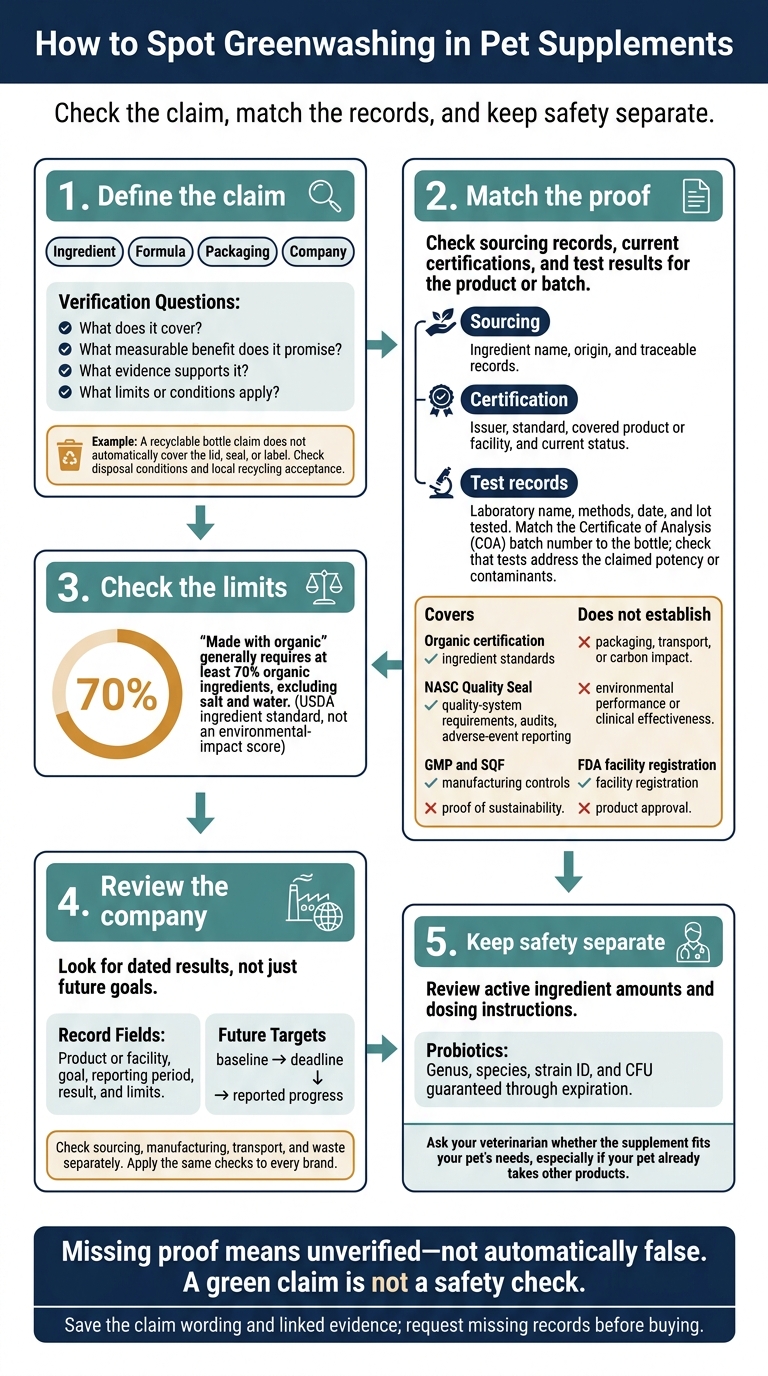
How to Spot Greenwashing in Pet Supplements
Greenwashing in the Pet Industry with Girls Gone Raw
sbb-itb-6d7d69d
Step 1: Define What Each Green Claim Covers
Review the package and online listing together. Check whether each claim applies to the supplement, one ingredient, the package, or the company. Use the FTC Green Guides to assess broad environmental claims, and check current guidance before relying on a specific claim. First, identify the claim type. Then compare its wording with the evidence.
Separate Specific Claims From Vague Terms
“Clean,” and “eco-friendly,” can function as vague marketing terms if they are not tied to a specific, verifiable claim.
One appealing ingredient can make the entire formula seem greener than it is. For sourcing claims, look for the ingredient name, its source, and supporting evidence - not just a reassuring adjective. Check whether the claim covers the package, the formula, or both.
Check Packaging, Energy, and Carbon Claims
For packaging, energy, and carbon claims, start with the same check: What exactly does the claim cover?
A recyclable bottle claim doesn't automatically apply to the lid, seal, or label. Identify the component covered, then check disposal instructions, required conditions, and whether local recycling programs accept it.
For renewable energy or carbon-neutral claims, ask which energy source the claim refers to, whether offsets support it, and what records back it up. A packaging claim applies to the package - not the product's full footprint. Test each claim with the four questions below.
Ask 4 Questions About Each Claim
- What does it cover?
- What measurable benefit does it promise?
- What evidence supports it?
- What limits or conditions apply?
Save the claim wording and linked evidence before buying. If the scope or proof is missing, treat the claim as unverified.
Step 2: Check Labels, Sourcing, and Certifications
Once you’ve defined what each claim covers, check whether the label, sourcing records, and certifications back it up.
Review Ingredients and Manufacturing Details
Read the ingredient and product panels - not just the front label. Look for ingredient names, listed amounts, expiration dates, and lot or batch details that support the claim. Don’t assume human Supplement Facts rules apply. Pet supplement labels follow AAFCO/model-labeling rules, and ingredient names or their order can vary by product class.
Ask where the ingredients come from, where the product is made, and for finished-product test results. For probiotics, check the genus, species, strain ID, and CFU guaranteed through expiration. Claims such as made in the USA, non-GMO, human-grade, and clinically tested each need their own evidence.
Confirm What Certifications Cover
Check with the issuing organization to verify the certifier, standard, covered product or facility, and current status. Under USDA rules, “made with organic” generally requires at least 70% organic ingredients, excluding salt and water. Organic certification covers ingredient standards - not packaging, transport, or carbon impact.
The NASC Quality Seal addresses quality-system requirements, including audits and adverse-event reporting. It does not cover environmental performance or clinical effectiveness. GMP and SQF cover manufacturing controls; FDA facility registration does not mean a product is approved.
Match Claims to Supporting Records
Match the exact claim wording to certificates or test records for the specific product or lot. Check the facility and reporting period as well. For a Certificate of Analysis (COA), confirm that the batch number matches your bottle and that the tests address the claimed potency or contaminants. If records aren’t public, ask for them - don’t treat their absence as automatic proof of greenwashing.
| Marketing wording | What it might cover | Records to request | Warning sign |
|---|---|---|---|
| Made in the USA | Final manufacturing or assembly | Manufacturing location, FDA facility registration, and GMP or SQF certifications | No explanation of whether the claim covers final assembly, ingredient sourcing, or both |
| Non-GMO | Ingredients or finished product | Third-party testing or GMO-free certification | No supporting documentation |
| Sustainably sourced | Ingredient sourcing | Traceable sourcing records and contaminant testing | No origin or testing details |
| Organic | Ingredients | USDA organic certification and ingredient percentage | Wording does not match certification |
| Third-party tested | Finished product or specified ingredients | Laboratory name, methods, date, and lot tested | No lab name, method, date, or lot number |
Step 3: Review Company Disclosures
After checking labels and certifications, review the company’s own disclosures for proof of progress.
Check Policies, Results, and Limits
Look for written policies that identify the product or facility, goal, reporting period, result, and any limits. Check sourcing, manufacturing, transport, and waste separately. A future target isn’t proof of progress. Before giving it credit, check the baseline, deadline, and reported progress.
Confirm that each claim is current, measurable, and tied to the product. Match it to a dated policy, report, or disclosure page - not the brand’s overall image. Save dated screenshots of current disclosures. If evidence is missing, request the record using the exact claim and product name, then keep the company’s response.
Keep environmental claims separate from quality and safety claims. Verify manufacturing certifications such as GMP and SQF, along with FDA facility registration, separately from environmental disclosures. Quality controls and testing do not prove sustainability.
Apply the Checklist to Vet Treat
Apply the same disclosure check to any brand page, including Vet Treat.
For natural and non-GMO claims, request ingredient definitions and sourcing records. For claims that products are manufactured in U.S.-based FDA-registered, GMP-certified facilities, request manufacturing details and clarify which production stages and ingredient origins are included. For third-party purity testing, request product-level test records.
For clinically tested or veterinarian-recommended claims, request the product-level evidence. These are quality signals, not proof of environmental performance.
Conclusion: Verify Claims Before Buying
Before you buy, check the exact green claim, what it covers, and the records behind it. Make sure the certification or test supports that specific claim. Compare the packaging’s disposal instructions with your local recycling rules.
If supporting records are missing, treat the claim as unverified.
Green claims do not replace safety checks. Review active ingredient amounts and dosing instructions. For probiotics, look for named strains and a CFU count guaranteed through expiration. Talk with your veterinarian before adding another supplement, especially if your dog already takes other products. Packaging alone cannot tell you whether your dog needs the supplement - or whether it’s safe.
FAQs
How can I verify a supplement’s sustainability claims independently?
Look for third-party certifications, such as the National Animal Supplement Council (NASC) seal, which indicates external audits of quality control and label accuracy. Also check for published testing or independent verification confirming that ingredient potency and purity match the label.
Skip vague proprietary blends that hide ingredient doses. Choose products with clearly named ingredients, traceable sourcing, and transparent manufacturing standards, such as production in FDA-registered, GMP-certified facilities.
Where can I report misleading green claims?
Report misleading green claims or suspicious pet supplement marketing to your local veterinary association or animal welfare organization. These groups can share product safety information and track reported issues.
Pet supplements aren’t regulated the same way as drugs, so discuss product concerns with your veterinarian. Your vet can help you assess the evidence behind a brand’s claims.
How do I balance sustainability with my pet’s health needs?
Start with evidence-based care, not extra supplements. A complete and balanced commercial diet supplies the nutrients your dog needs. Adding supplements without a clear need can waste money or cause harm.
If your dog has a diagnosed health issue, consult your veterinarian. Choose high-quality, third-party-tested products from reputable brands that clearly explain where their ingredients come from and use science-backed doses. This targeted approach helps prevent over-supplementation and keeps your time and money focused on your pet’s health needs.