

Dog Supplement Shelf Life: Owner Guide
Dog supplements have no single shelf life. My rule: follow the package date, storage directions, and any limit after opening - whichever deadline comes first. <u>Damage or spoilage overrides the date.</u>
I use these 4 checks to decide whether to keep or replace a product:
- Delivery: Check the seal, container, date, and lot number. Save the label and report damaged or temperature-sensitive shipments before use.
- Home storage: Keep products sealed and dry. Record the opening date, and refrigerate only if directed - including probiotics and hip and joint supplements.
- Travel: Stay within the label’s temperature limits, never leave supplements in a parked car, and check them again afterward.
- Replacement: Stop use for mold, unusual odors, leaks, moisture, or other changes. If storage conditions are uncertain, ask the manufacturer before giving another dose.
These checks apply to allergy chews, tablets, powders, oils, liquids, probiotics, and Vet Treat products. Looks alone cannot confirm safety. If your dog eats a questionable product or too many doses, call your veterinarian promptly - don’t wait for symptoms.
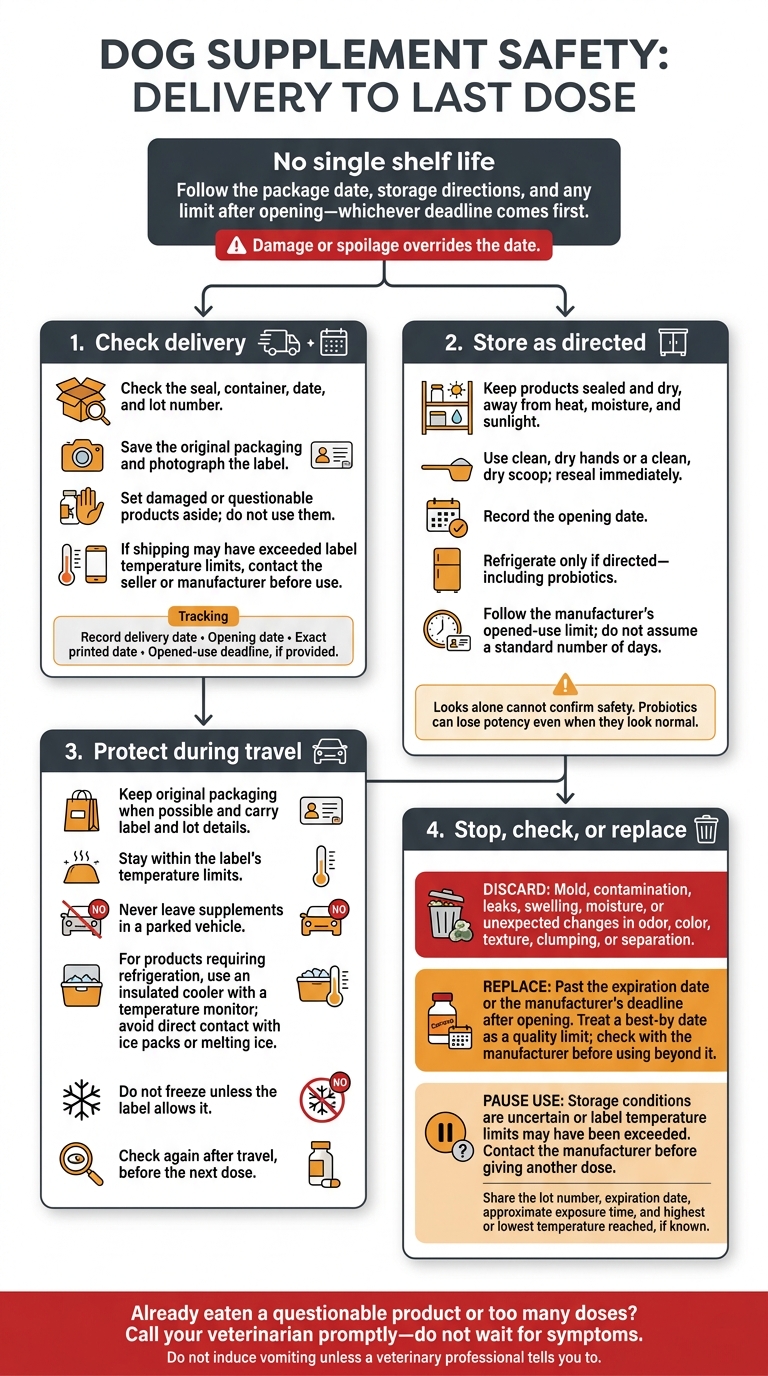
Dog Supplement Shelf Life: 4 Safety Checks
Delivery Day: Check the Package and Dates
Before taking the first dose, check the product name, size, count, expiration or best-by date, lot number, seal, and container condition. Look for damage, leaks, swelling, moisture, clumps, mold, or unusual odors. Set questionable products aside; do not use them. Take photos of any damage and contact the seller for replacement or disposal instructions.
Temperature matters most for products that can spoil during shipping. Note whether the delivery arrived hot, cold, or late. Appearance alone can’t confirm safe shipping temperatures, especially for temperature-sensitive probiotics like those in a daily multivitamin. If the label requires refrigeration, prohibits freezing, or gives another temperature limit that may have been exceeded, contact the seller or manufacturer before use.
If something seems wrong, save the package details before opening or discarding it.
Save the Original Packaging and Product Details
Keep the original container. For damaged deliveries, also save the shipping box, packing materials, receipt, and order number until the seller resolves the issue.
Photograph the label, dosing directions, storage instructions, date, lot number, and manufacturer contact details. Having these details handy makes later storage checks and recall lookups faster.
Record Delivery, Opening, and Use Deadlines
Use a simple phone note or paper log, and copy the printed date exactly. If the date format isn’t clear, ask the manufacturer instead of guessing. Save its explanation alongside the original wording.
Start tracking these details on delivery day so you can follow the earliest valid deadline.
| Item to track | What to record |
|---|---|
| Delivery date | Date the product arrived |
| Opening date | Date you first broke the seal |
| Printed date | Exact wording and date from the label |
| Opened-use deadline | Record this only if the manufacturer gives an opened-use period |
| Earliest discard date | Earliest applicable deadline, accounting for storage history and product condition |
Set an opened-use reminder only if the manufacturer provides that timeframe. Follow the printed date, storage directions, and any manufacturer instructions, using whichever applicable limit comes first.
sbb-itb-6d7d69d
Home Storage: Before and After Opening
Once the package passes inspection, proper storage helps preserve quality.
Unopened Supplements: Keep Sealed and Store as Directed
Keep unopened supplements sealed in a cool, dry cabinet away from heat, moisture, and sunlight - not in a garage or on a porch. Follow the storage directions and printed expiration or best-by date rather than guessing how long a product will last.
Use the label’s temperature range in °F. There’s no single storage standard for all supplements. Once you open a product, record the date so you can track when it needs closer monitoring.
Opened Chews, Tablets, and Powders: Keep Clean and Sealed
Use clean, dry hands or the supplied dry scoop, and reseal the container immediately after each dose. Keep moisture and crumbs out. Never mix products between containers or transfer them to unmarked jars or bags.
Follow the manufacturer’s opened-use limit. Don’t assume every product lasts the same number of days after opening.
Storage by Format: Dry Products, Oils, Liquids, and Probiotics
Follow the label first. Use the format-specific warnings below only when needed.
| Product format | Main integrity concern | Storage rule | Replacement warning |
|---|---|---|---|
| Dry chews and tablets | Moisture, heat, humidity, and texture changes | Keep sealed, store exactly as directed, and use dry hands | Replace if soft, hard, sticky, moldy, discolored, or foul-smelling. |
| Powders | Moisture absorption, clumping, contamination, and loss of uniform dosing | Use a clean, dry scoop; close tightly; refrigerate only if directed | Replace if wet, caked, contaminated, or discolored. |
| Oils | Oxidation from heat, light, and air | Keep tightly closed and protected from light at the label-directed temperature | Replace if rancid-smelling, unusually dark, or leaking. |
| Other liquids | Microbial contamination, leakage, and separation | Follow the label for refrigeration, shaking, and opened-use limits | Replace if odor, color, texture, leakage, or separation changes unexpectedly, or if contamination is suspected. |
| Probiotics | Loss of viable organisms from heat, moisture, oxygen, or time | Follow the label’s temperature and moisture instructions; don’t assume refrigeration is required | Replace after the printed date or manufacturer limit, or after improper storage. |
Refrigerate only when the label says to. Cold storage won’t fix spoilage or contamination, and probiotics can lose potency even when they look normal.
Travel adds another storage risk: temperature changes.
Travel Storage and Daily Doses
Heat, time, and handling during travel can shorten a supplement’s shelf life.
Pack Labeled Doses and Control Storage Temperature
Pack only the doses you need, plus a small reserve for delays. Keep them in their original packaging when possible. If the manufacturer allows you to transfer doses, use a clean, dry, sealed container labeled with the product name, dose, expiration date, and storage directions. Carry a photo of the label and lot number, and check the product again after your trip before taking a dose.
Keep liquids upright in a leakproof outer bag. Protect supplies from heat, sunlight, spills, and crushing. Never leave supplements in a parked vehicle or anywhere outside the label’s storage temperature range. On road trips, bring them inside at stops and into your lodging.
If the product needs refrigeration, use an insulated cooler with a temperature monitor. Keep the package away from direct contact with ice packs and melting ice. Don’t freeze it unless the label specifically allows it. Before flying, check carry-on and cooling rules. When permitted, keep temperature-sensitive supplements in your carry-on and plan cooling for security lines and delays - not just the flight.
Check Supplements After Travel
Before your next dose, check for condensation, leakage, damaged packaging, clumping, discoloration, or an unexpected odor or texture. Discard anything wet, contaminated, or damaged.
If you’re unsure about storage conditions, pause use and contact the manufacturer. Provide the lot number, expiration date, approximate exposure time, and the highest or lowest temperature the product may have reached. Heat, moisture, or freezing outside the label’s limits may mean it needs early replacement. Ask whether to replace it before your next dose, and don’t take that dose until the product is cleared for use.
Conclusion: When to Replace Dog Supplements
Discard supplements as soon as any check fails: date, seal, storage, or product condition. After travel, inspect them before giving the next dose.
Follow a Replacement Checklist
Replace supplements once they pass the expiration date or the manufacturer’s deadline for use after opening. Treat a best-by date as a quality limit, and check with the manufacturer before using the product beyond that date.
Discard supplements if you find mold, live insects, swelling, leakage, moisture, unexpected clumping, stickiness, discoloration, broken capsules, unexpected liquid separation, or a rancid or unusual odor.
If a product was contaminated, stored incorrectly, or has an unknown storage history, stop using it and replace it unless the manufacturer or veterinarian can confirm it is still suitable. Never taste a questionable supplement or give extra doses just to empty the container.
Call a Veterinarian About Suspected Spoilage or Overdose
If your dog has already eaten a questionable product, focus on safety rather than storage. Act before symptoms appear. If your dog may have eaten spoiled supplements or too many doses, promptly call your veterinarian or the ASPCA Animal Poison Control Center at (888) 426-4435. Fees may apply.
Have the packaging, product name, active ingredients, lot number, estimated amount eaten, time eaten, and your dog’s weight ready. Do not induce vomiting unless a veterinary professional tells you to.
Store Vet Treat Chews as Directed
For Vet Treat chews, follow the storage directions and expiration information on that specific package. Keep the original container tightly sealed, and record the opening date. Brand claims do not override the package date or storage directions.
If you notice changes in odor, texture, color, or moisture - or damage to the package - stop use and contact Vet Treat or a veterinarian for guidance.
FAQs
What if my dog’s supplement has no expiration date?
Without an expiration date, you can’t verify how long the active ingredients stay effective or confirm the supplement’s quality over time. An expiration date is an important indicator of potency and safety.
When buying daily supplements for your dog, look for clearly listed expiration dates and quality checks, such as the NASC Quality Seal or records of independent third-party testing.
Does a best-by date mean the same as an expiration date?
No. A best-by date is the manufacturer’s estimate of how long a supplement will meet quality and potency standards when stored correctly. It doesn’t guarantee safety until that date or mean you must use it by then.
Potency can decline over time, and heat, light, and oxygen can make a supplement less effective. Follow the storage instructions on the label, and replace the supplement after its best-by date.
What if there’s no use-by deadline after opening?
Don’t assume it will last forever. Check the label’s expiration date and lot information, and follow the storage directions to limit exposure to heat and moisture. Watch for possible changes in quality or potency, especially with probiotics: their viability can decline after opening.
Ask the manufacturer for third-party testing records or a certificate of analysis (COA) that matches your bottle’s lot. Without matching records, potency can’t be verified.