

Dog Metabolism Support: Vet Ingredient Guide
Metabolism chews won’t make your dog lose weight without a calorie deficit. My starting point: ask your vet for a daily calorie target, and keep treats and chews below 10% of that total.
Here’s what I’d check before choosing a chew:
- The plan: Your dog’s age, activity, muscle, and health - not just the number on the scale.
- The ingredients: L-carnitine, fiber, omega-3s, probiotics, and antioxidants have different roles. None replaces calorie control.
- The label: Look for ingredient amounts, calories per serving, safety warnings, and research on the formula. <u>Never give a product containing xylitol.</u>
- The follow-up: Track weight every 2 weeks during weight loss, watch for muscle loss or stomach upset, and review changes with your vet.
My rule: choose a chew only if it fits your dog’s whole feeding plan - not because the package promises “metabolism support.”
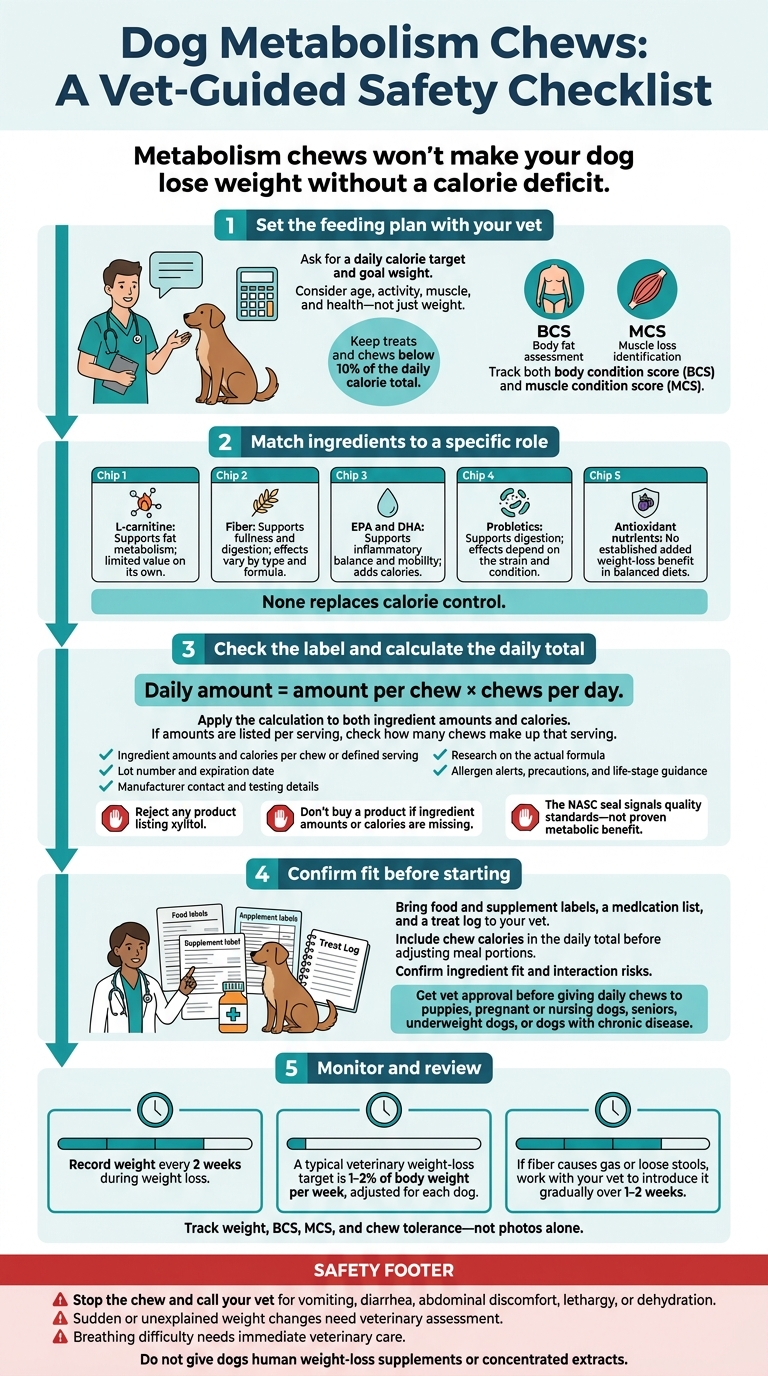
Dog Metabolism Chews: A Vet-Guided Safety Checklist
Veterinarian's Rx for Canine Weight Loss Success
sbb-itb-6d7d69d
How Dog Metabolism and Weight Control Work
Food fuels your dog’s organs, body temperature, and movement. Resting energy requirement (RER) covers basic needs at rest; activity takes extra energy. Weight control starts with balancing calories, measuring portions, staying active, and checking progress regularly. Vets use these same factors to judge whether a chew’s ingredients fit your dog’s plan.
Calorie Needs, Body Fat, and Muscle
Your dog’s size, muscle mass, activity, neutering status, and health all affect calorie needs. Ask your vet to set a daily calorie target and goal weight.
Track body condition score (BCS) and muscle condition score (MCS) together. The WSAVA 9-point BCS measures body fat, while MCS helps spot muscle loss that body fat can hide. For dogs that need to lose weight, a typical veterinary target is 1–2% of body weight per week, adjusted for each dog.
Meals, Exercise, and Chew Calories
Use a digital kitchen scale to weigh meals in grams instead of relying on measuring cups. During active weight loss, record your dog’s weight every two weeks. Include chew calories in the daily total before adjusting meal portions. If calorie cuts exceed 10–15%, ask your vet whether a veterinary therapeutic diet would better maintain protein, vitamin, and mineral intake.
For sedentary dogs, start with 10–15-minute walks, two or three times daily, and gradually increase activity as tolerated. Dogs with painful joints or severe obesity may need supervised hydrotherapy or swimming instead.
With a calorie budget in place, review whether a chew’s ingredients fit the plan without adding excess calories.
Age, Breed, and Health Factors
Age, breed, activity level, and disease can change how many calories a dog needs. Dogs with endocrine disorders, such as hypothyroidism or Cushing’s disease, need individual veterinary advice before dietary changes or daily chews. The same applies to dogs with diabetes, parasites, or organ disease.
These needs also shape chew selection:
| Life stage or dog type | Primary nutritional consideration | Reason for veterinary review |
|---|---|---|
| Puppies | Growth and nutrient density | Support skeletal development without excess calories. |
| Adults | Calories matched to activity and reproductive status | Adjust portions after neutering or activity changes. |
| Seniors | Muscle preservation and slower metabolism | Monitor metabolic changes and muscle loss. |
| Small breeds | Higher calorie needs per pound; tighter calorie control | Small calorie errors can cause weight gain. |
| Large and giant breeds | Joint stress and growth rate | Limit excess weight on developing joints. |
| Working dogs | Higher calorie density to maintain muscle | Match calories to performance needs. |
Vets also account for these differences when deciding how much fiber, fat, or calories a daily chew can add.
Supplement Ingredients Vets Review
Vets assess these ingredients for metabolic support - not as stand-alone weight-loss tools. After setting calorie intake, they check what each ingredient may help with, how well the dog tolerates it, and whether the label is accurate.
| Ingredient | Intended role | Evidence level | Common label forms | Veterinary cautions |
|---|---|---|---|---|
| L-carnitine | Supports fat metabolism | Used in weight-management diets; limited value on its own | L-carnitine | Use only as part of the full weight plan. |
| Fiber | Supports fullness and digestion | Effects vary by fiber type and formula | Cellulose, chicory root, inulin | Too much - or adding it too suddenly - can cause digestive upset. |
| EPA and DHA | Supports inflammatory balance and mobility | Moderate to strong for specific conditions | Fish oil, krill oil, algal oil | Adds calories; high doses can affect clotting. |
| Probiotics | Supports digestion | Effects depend on the strain and condition | Named strains of Enterococcus faecium or Bifidobacterium | Check strain details, storage needs, and whether live organisms are guaranteed through the expiration date. |
| Antioxidant nutrients | No proven weight-loss benefit | No established added weight-loss benefit in balanced diets | Vitamin E, vitamin C, selenium | Review total nutrient intake instead of stacking supplements. |
Each ingredient needs to fit the dog’s calorie target, meal portions, and exercise plan. Vets most often assess fat metabolism, fullness, gut support, and inflammation control.
L-Carnitine and Fiber
L-carnitine appears in weight-management diets, while fiber’s effects depend on the type used. Inulin and other fermentable fibers feed gut bacteria. Cellulose adds bulk with little usable energy.
Fiber tolerance depends on both the formula and the dog. If it causes gas or loose stools, work with your vet to introduce it gradually over 1–2 weeks.
Omega-3s, Probiotics, and Antioxidants
For omega-3s, check the individual EPA and DHA amounts - not just the total “fish oil” amount. Dogs convert plant-based ALA to EPA and DHA poorly.
Probiotic effects depend on the strain; prebiotics feed gut bacteria. Extra antioxidants have no established weight-loss benefit for dogs eating a complete and balanced diet.
Stimulants and Ingredients That Need Caution
Do not give dogs human weight-loss supplements or concentrated extracts. Human supplements may contain toxic xylitol or unsuitable amounts of vitamin D and iron. Herbal products and certain supplements can also interact dangerously with medications, especially anesthetics and NSAIDs. Label checks matter even more when a dog takes medication or has surgery scheduled.
How to Read Daily Chew Labels
Once you know which ingredients matter, check the label for exact amounts and calories.
Ingredient Amounts, Serving Size, and Calories
Compare the website listing with the jar label before buying or feeding the chew. Daily amount = amount per chew × chews per day. Use this calculation for both ingredients and calories. If the label lists values per serving, check how many chews make up that serving. Make sure the directions fit your vet’s plan, including your dog’s calorie target and life stage.
Check the ingredient list for allergens and sweeteners. Reject any product listing xylitol. If the chew contains added vitamins or minerals, confirm that they fit your dog’s complete diet. Don’t buy a product if ingredient amounts or calories are missing.
Label Details and Warning Signs
Use this checklist to separate useful label details from marketing language.
| Label detail | Useful disclosure | Warning sign |
|---|---|---|
| Amounts | Each active ingredient’s amount per chew or defined serving | No per-ingredient amounts; only a combined blend weight |
| Calories | Calories per chew or defined serving | No calorie information |
| Batch/date | Lot number and expiration date | Missing batch details or dates |
| Contact information | Accessible manufacturer contact and testing details | No way to ask questions or request testing information |
| Research | Studies on the actual formula | Marketing claims, testimonials, or ingredient-only studies |
| Warnings | Allergen alerts, precautions, and life-stage guidance | Xylitol or missing safety guidance |
Marketing claims don’t prove a benefit. Check whether research on the actual formula matches its ingredient amounts, the dogs studied, and the intended use. The NASC seal signals quality standards - not proven metabolic benefit.
Applying the Label Checks
Apply these checks to any daily chew product: amounts, serving size, calories, warnings, and formula-specific research. Ask the manufacturer for missing warnings or research details, and bring the label to your vet. Do not treat a wellness chew as metabolic support unless the formula has ingredient amounts and research that match that use.
Conclusion: Review Your Dog's Plan With a Vet
Before starting daily chews, ask your vet to check that the ingredients and calories on the label fit your dog’s daily calorie target and health plan.
What to Check Before Starting Daily Chews
Bring food and supplement labels, a medication list, and a treat log. Ask your vet to confirm your dog’s target weight, body condition score (BCS) and muscle condition score (MCS) goals, daily calories, ingredient fit, and any interaction risks. Get vet approval before giving daily chews to puppies, pregnant or nursing dogs, seniors, underweight dogs, or dogs with chronic disease.
Once you’ve set the plan, schedule weigh-ins every 2 weeks during weight loss. Track weight, BCS, MCS, and how well your dog tolerates the chews - don’t rely on photos alone.
Weight Changes and Symptoms That Need Vet Care
Stop the chew and call your vet if your dog develops vomiting, diarrhea, abdominal discomfort, lethargy, or dehydration. Sudden or unexplained weight changes also need a veterinary assessment because they may point to an underlying health problem.
Breathing difficulty needs immediate veterinary care. Keep the product label handy so your vet can review what your dog received.
FAQs
Why isn’t my dog losing weight on fewer calories?
Hidden calories, incorrect portion sizes, or health conditions could explain why your dog isn’t losing weight. Every calorie counts - including table scraps, training treats, and daily supplements - so include them in your dog’s daily calorie budget.
If your dog keeps gaining weight despite controlled portions and activity, hypothyroidism or Cushing’s disease could be a factor. Talk with your veterinarian about an exam and possible lab work to check for medical causes.
How can I tell if a chew is helping my dog?
Track your dog’s behavior, energy levels, and symptoms for two weeks before starting the chew. This gives you a baseline to compare against.
Use the chew daily for 4 to 8 weeks before judging the results. During that time, keep a daily log of stool consistency, appetite, energy, and joint stiffness.
If you don’t see clear improvement after 4 to 8 weeks, talk with your veterinarian about changing the dose or trying another approach.
Does my dog need chews if their food contains these ingredients?
A complete and balanced diet likely supplies the vitamins and minerals your dog needs. It may also include fiber or prebiotics, so healthy dogs with stable health may not need extra chews.
Too much of certain nutrients can be dangerous, including fat-soluble vitamins and calcium. Before adding chews, review them and your dog’s food label with your veterinarian. Together, check for overlapping nutrients, safety concerns, and whether the supplement meets a diagnosed health need.