

Ultimate Guide to Calming Chews for Dogs
Calming chews may help with short-term stress, but they don’t replace treatment for an anxiety disorder. I’d start with a dog-specific formula that lists ingredient amounts and weight-based servings, then check it with your veterinarian - especially if your dog takes medication.
Here’s my checklist before giving a chew:
- Check the formula: L-theanine and alpha-casozepine have some research support, but studies are limited. For hemp products, confirm what “hemp oil” means and ask for batch test results.
- Plan the timing: Some situational chews may work within 30–60 minutes; daily formulas may take 2–4 weeks. Follow the product’s directions.
- Compare the cost: A $30 container with 60 chews costs $0.50 per chew, not necessarily per day. Your dog’s serving determines the daily cost.
- Track behavior, not just sleepiness: I’d look for less pacing, easier settling, and faster recovery while keeping training and a calm routine in place.
- Know when to stop: Contact your vet about side effects or worsening stress. Trouble breathing, collapse, self-injury, or a suspected overdose needs urgent veterinary care.
My goal is less distress - not simply more sedation. <u>A clear label, veterinary guidance, and a response log</u> are better guides than marketing claims, whether you’re considering Vet Treat’s formula or another chew.
How to Choose Calming Chews
Start with the label - not the marketing. Choose a dog-specific formula that lists active amounts per chew and gives weight-based directions. “Natural,” veterinarian endorsements, and customer reviews alone don’t prove a chew is safe or effective.
Calming Ingredients: Evidence and Risks
Research on an ingredient doesn’t prove that a finished blend works. Choose a formula that fits your dog’s age, health conditions, allergies, and medications.
| Ingredient | Use | Evidence limitations | Safety considerations |
|---|---|---|---|
| L-theanine | May reduce fear behavior | Limited; small controlled trials | Generally well-tolerated |
| L-tryptophan | Mood balance | Limited canine data | Do not combine with SSRIs without veterinary guidance |
| Melatonin | Nighttime settling | Weak; strong canine-specific trials are lacking | Can cause over-sedation in sensitive dogs |
| Valerian root | Relaxation support | Very weak; support comes mostly from human use | Watch for lethargy and ask your vet before combining with medications |
| CBD | May help with separation or travel stress | Mixed; trials disagree on benefits across situations | Must be THC-free; may interact with trazodone |
| Probiotics | Gut-brain axis support | Strain-specific and still being studied | Look for named strains and CFUs |
| Alpha-casozepine | Situational stress support | Limited; effects are modest | Check for dairy sensitivities |
A label that says hemp oil needs a closer look. Confirm whether it means hemp seed oil or a CBD-rich extract - they’re not the same. Avoid products with xylitol, concentrated essential oils, or proprietary blends that hide what your dog is getting.
Check Labels, Testing, and Cost
Check the exact active amounts per chew, weight ranges, serving frequency, inactive ingredients, lot number, and expiration date. Look for an NASC quality seal and third-party testing that confirms ingredient identity and checks for contaminants, including heavy metals, pesticides, and THC in hemp products.
To work out the daily cost, divide the total price by the number of chews. Then multiply that amount by your dog’s daily serving.
A $30 container with 60 chews costs $0.50 per chew, but that does not mean it provides 60 daily servings.
Review Vet Treat’s Calming Formula
Vet Treat’s Dog Calming Anxiety & Stress Relief lists hemp oil, valerian root, and melatonin. Before buying, check the milligrams per chew, weight-based directions, and batch test results. Also confirm whether the hemp ingredient is hemp seed oil or a CBD-rich extract. Once you’ve narrowed down the formula, match the serving to your dog’s weight and current medications.
sbb-itb-6d7d69d
How to Give Calming Chews Safely
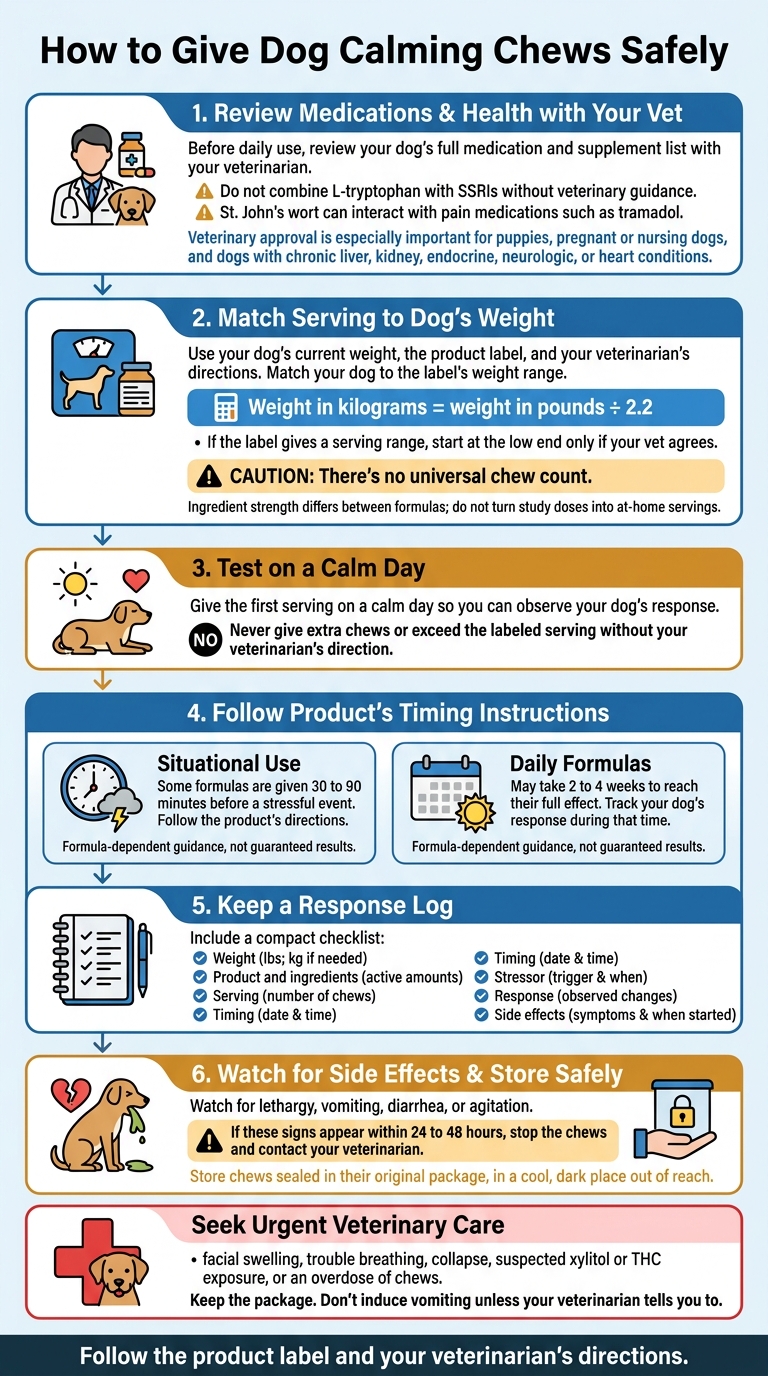
How to Give Dog Calming Chews Safely
Set the Serving by Weight
Once you’ve chosen a formula, follow the label - not guesswork.
Set the serving using your dog’s current weight, the product label, and your veterinarian’s directions. Match your dog to the label’s weight range. If it lists kilograms, divide your dog’s weight in pounds by 2.2. If the label gives a serving range, start at the low end if your vet agrees.
There’s no universal chew count. Ingredient strength differs between formulas, so don’t turn study doses into at-home servings.
Give the first serving on a calm day so you can watch how your dog responds. For situational use, some formulas are given 30 to 90 minutes before a stressful event. Never give extra chews or exceed the labeled serving without your veterinarian’s direction.
Use this log to track whether the chew helps with specific triggers over time.
| Track | What to record |
|---|---|
| Weight | Pounds; kilograms if needed |
| Product and ingredients | Product name and active amounts per chew |
| Serving | Number of chews given |
| Timing | Date and time |
| Stressor | Trigger and when it occurred |
| Response | Observed changes |
| Side effects | Symptoms and when they started |
Daily Use and Medication Precautions
Before giving chews daily, review your dog’s full medication and supplement list with your veterinarian. Daily formulas may take 2 to 4 weeks to reach their full effect, so track your dog’s response during that time.
Some ingredients interact with prescription drugs. For example, don’t combine L-tryptophan with SSRIs without veterinary guidance. St. John’s wort can also interact with pain medications such as tramadol.
Veterinary approval is especially important for puppies, pregnant or nursing dogs, and dogs with chronic liver, kidney, endocrine, neurologic, or heart conditions.
Side Effects and Emergency Warning Signs
Even gentle formulas can cause side effects, especially when you first start giving them. Watch for lethargy, vomiting, diarrhea, or agitation. If these signs appear within 24 to 48 hours, stop the chews and contact your veterinarian.
Seek urgent veterinary care for facial swelling, trouble breathing, collapse, suspected xylitol or THC exposure, or an overdose of chews. Keep the package, and don’t induce vomiting unless your veterinarian tells you to.
Store chews sealed in their original package, in a cool, dark place out of reach.
Build a Routine and Track Results
Once you’ve set the serving size, keep the routine consistent. This makes it easier to compare the chew’s effects over time.
Prepare for Known Stress Triggers
Start with a predictable routine that includes exercise, enrichment, rest, and a quiet, safe space. Watch for early signs of stress before they escalate.
Give the chew before known triggers, following the product’s timing instructions. Don’t use chews to push your dog through a fear trigger. Keep the trigger and timing the same for each comparison so your log stays useful.
When to Expect Results and What to Track
Whenever possible, track the same event under the same conditions and follow the product’s timing instructions. Progress means milder stress, easier settling, or faster recovery. Short videos can help you compare your dog’s response to the same trigger over time.
Log settling time, pacing, vocalization, trembling, and recovery time to measure the chew’s effects. Change only one factor at a time during the trial.
When to Review the Plan
Before starting, agree on a fixed 4-week trial with your veterinarian. At that review, decide whether to continue, adjust the plan with your veterinarian, or stop.
If there’s no clear improvement after 6 to 8 weeks, review the plan with your veterinarian. Do the same if side effects or worsening symptoms appear. Consult your veterinarian before adding prescription medication. Persistent moderate or severe anxiety may need a veterinary behavior plan and prescription treatment - not more chews.
Conclusion: Choose Carefully and Monitor Your Dog
Once the trial starts, assess the chew by changes in your dog’s behavior - not marketing claims. Choose based on evidence and a clear label, not “natural” claims alone. Calming chews should be part of a broader plan that includes trigger management, reward-based training, and veterinary care.
Before buying Vet Treat’s calming chews, check the active ingredients, the amount per chew, and the weight-based directions. Ask for third-party test results for safety, purity, and potency. Review the formula and any prescription medications with your veterinarian. These checks make it easier to track and compare results during the first few weeks.
Success means fewer anxiety behaviors over time without side effects, not simply a dog who seems sedated. If side effects appear, stop giving the chew and contact your veterinarian.
FAQs
How can I tell stress from an anxiety disorder?
The difference often comes down to severity and persistence. Stress is a natural response to triggers such as loud noises, travel, or separation. An anxiety disorder, on the other hand, is a persistent clinical condition - not a passing mood.
If your dog hurts themselves, can’t be calmed during an episode, or gets worse despite your efforts to manage their symptoms, they may need professional veterinary care, not supplements alone.
Can calming chews lose effectiveness over time?
Yes. Calming chews can lose potency over time or when stored incorrectly. Heat, light, and oxygen can break down their active ingredients.
Keep your Vet Treat supplements in their original, airtight packaging in a cool, dark place to help preserve their effectiveness. Check expiration dates monthly, since ingredient potency naturally decreases as the chews age.
Should I stop calming chews gradually?
Whether to taper off calming chews depends on your dog’s needs and why they take them. These chews are designed for consistent daily use, so talk to your veterinarian before changing the routine. Your vet can review your dog’s health history and the supplement’s ingredients to determine whether tapering is needed.
Watch your dog closely for behavior changes as you adjust or stop the chews.